Table Of Contents
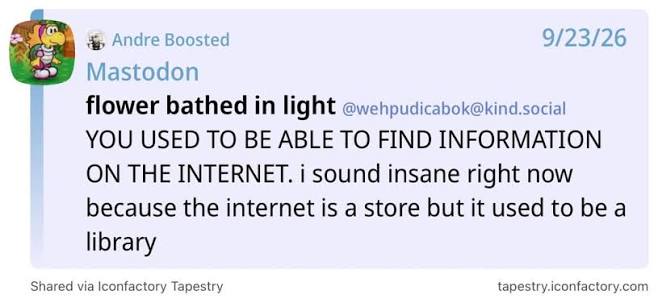
flower bathed in light @[email protected] YOU USED TO BE ABLE TO FIND INFORMATION ON THE INTERNET. i sound insane right now because the internet is a store but it used to be a library Shared via Iconfactory Tapestry
A meme circulates that says, "The internet used to be a library and now it's a store." I have been thinking a lot about that meme this week, as shopping websites seem legion, along with all the gambling I mean, prediction market apps. They are almost inescapable, and I also learned about the dopamine sites. In these fake storefront checkout experiences, you can scroll, select, check out, purchase, get fake fulfillment messages, and track your fake package. These sites like FoodNeverComes fulfill the retail therapy itch, and they may indeed be "harm reduction," but they are also well-designed dopamine factories.
To revise the meme, what I am seeing, and what worries me, and what I see in myself too, is that the internet used to be a library, but now it is a dopamine economy. We buy and sell "real" and imagined products through our time, attention, and unlimited scroll.
Instead of reading, I find myself turning to an ebook or a physical book, or scrolling short-form video content (like SubwayTakes or jordan_the_stallion8 or all the cute animal videos); while the short-form content is fun, it's exactly that: fun, cute, sometimes zany.
Our Aesthetic categories #
During graduate school, in a reading group, we read Our Aesthetic Categories: Zany, Cute, Interesting by Sianne Ngai. While I can't recall exactly what I thought of the book back then, it has stuck with me. In fact, I think it is an incredibly prescient description of our current dopamine economy and says a lot about how people spend their time. The dopamine economy capitalized on all three categories, but short-form content and immersive dopamine sites thrive on zany and cute. While there may be interesting or informative content, it is often scrolled past, or creators who make interesting content also choose, or have to, make zany and cute content because the algorithm giveth and the algorithm taketh away. The intentionality of going to a site or a feed reader (anyone remember Google Reader) is fading; now it's scrolling on megaplatforms and feeding the algorithm gods to stay in front of the audience because that's where the people and the eyeballs are.
However, to fully disengage from the dopamine economy, I find myself deleting social media apps from my phone and logging out of apps, because nothing keeps me from logging in more than 2FA and passkeys. With these moves, I have had more time, and my curiosity and interest in exploring and learning more about the world around me are returning. For example, in the evenings I have been learning about the tildeverse thanks to Brennan and it's been fun again! I have gotten to play, make mistakes, learn, and do. I feel more active and less passive and reactive.
My excitement and desire to learn and read more online about tech have been met with sadness, as so many news magazines, sites, and blogs have faded away or are languishing behind a paywall. So where do we go? Where are the unique corners of the internet where curiosity dwells, humans explore the digital library, thumbing through the shelves in a haphazard, non-algorithmic way, bumping into other patrons (netizens), forging bonds and enjoying the digital commons. One place I'm presently re-exploring is IRC. It was there before AIM, and it has outlasted and outwitted AIM.
Growing up, I loved spending time online, reading, hanging out in interest groups, playing MUDs, and building on the web. However, as I grew older and changed, I moved away from spending so much time there and shifted from creating to consuming.
The Dopamine economy #
As I return once again to the "this used to be a library" meme, I am realizing how much I have been converting my time, energy, and money into quick dopamine fixes, rather than learning, creating, and, most critically, thinking. I got caught up in the speed of alerts, algorithms, and new, cool short-form video, so now I am working on returning to the library: hanging out in digital commons, reading, slow thinking, mulling things over, working through open tabs, asking questions, etc. Giving myself space to explore, being more intentional about where and how I spend my time, and trying to pull myself away from all the animal voice-over and cooking videos I shan't get around to.
So what blogs are you reading? What are your go-to places to learn and explore?
P.S. No AI was used in this post, not even grammarly
Webmentions
No webmentions yet.